Embedded Where It Delivers Operational Value
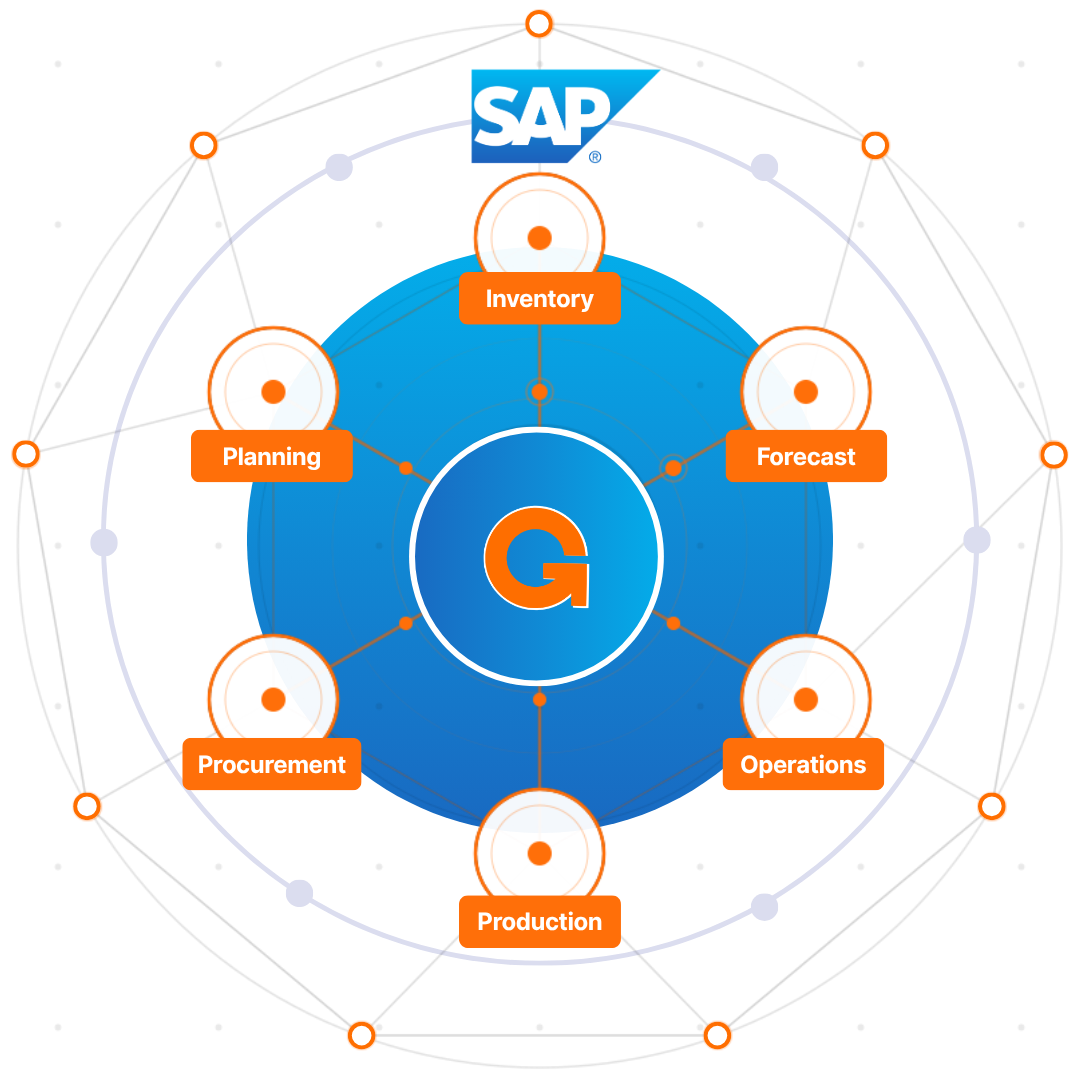
GIB integrates AI directly into supply chain workflows within SAP to improve how teams detect issues, evaluate decisions, and execute across procurement, inventory, and production.
01
Roadmap-driven, not trend-driven
AI capabilities are derived from product and customer requirements.
02
Secure integration, no added complexity
AI is built into GIB in a way that keeps your SAP environment clean: GDPR-compliant, audit-ready, and free of dependencies that create technical debt.
03
Pilot first, scale after validation
We prove value in a controlled context before broad deployment. AI capabilities expand only after they've demonstrated measurable impact.
04
Humans remain responsible
AI supports expertise — it does not replace it. Approvals, decisions, and accountability stay with your team.
Where manual effort accumulates in SAP supply chains
Supply chain teams make hundreds of operational decisions daily — evaluating shortages, adjusting procurement, balancing inventory, rescheduling production. Most of that work depends on assembling context from multiple SAP transactions, reports, and planning tools before any action can be taken.
Fragmented signals across transactions
Critical information is scattered across dozens of SAP transactions, reports, and dashboards. Teams manually piece together context before deciding what action to take.
Slow response to operational signals
Material shortages, supplier delays, and inventory imbalances often surface too late — after they've already constrained production or affected service levels.
Coordination across disconnected roles
Planners, buyers, and production teams often coordinate decisions through email or meetings rather than through structured workflows in SAP.
AI embedded in the GIB platform today
AI capabilities in GIB are already available across inventory management, demand forecasting, and production planning.
- Inventory Management
- Demand & Forecast
- Production Planning
- Cross-Functional
-
Inventory Management
Smarter inventory decisions — inside SAP
Carrying the right inventory across multiple locations requires balancing demand variability, supplier lead times, and service level targets continuously. GIB applies machine learning to safety stock optimization, recommending stocking levels based on consumption patterns rather than static rules.
Inventory segmentation is also AI-assisted. GIB clusters materials by behavior — consumption patterns, inventory value, volatility — to support more precise inventory policies at scale.
Master data management is supported by an AI agent built on large language models. The agent runs within SAP's AI infrastructure and can be configured to work with your existing master data context — reducing the manual effort typically required to manage data quality across complex SAP environments.
Safety Stock OptimizationMachine Learning · Predicts optimal stock levels from historical consumption patterns
Linear Regression · Models the relationship between demand variables and required inventory
Inventory SegmentationK-Means Clustering · Groups materials by similar behavior to apply the right inventory policy to each
Master Data ManagementAI Agent · Applies large language models to support master data tasks within SAP
-
Demand & Forecast
Forecast quality that improves what downstream teams act on
Forecast quality directly affects every downstream supply chain decision. GIB applies AI to time series clustering, material selection, and forecast accuracy improvement — strengthening the signals that planners act on before committing to procurement or production decisions.
GIB also monitors external risk signals — news, market data, supplier disruptions — using AI to flag potential supply chain risks before they show up in SAP transactions. The goal is earlier detection, not faster reaction after the fact.
AI-supported recommendations for identifying which materials most need active planning attention are available in current releases, with ongoing evaluation of additional forecasting methods.
Time Series ClusteringROCKET · Identifies patterns across demand histories to group materials with similar behavior
Material SelectionRandom Forest · Statistically ranks which materials most need active planning attention
Risk Signal DetectionLarge Language Models · Monitors external signals to surface supply chain risks before they appear in SAP
-
Production Planning
Production scheduling that accounts for real constraints
Production scheduling requires balancing material availability, capacity limits, and sequencing constraints at the same time. GIB's factory optimization capability uses mathematical constraint solving to improve how production schedules are built and adjusted — reducing the manual iteration that happens when planners discover conflicts late.
In active prototyping: AI-based prediction of how long production orders will actually take to complete. When planners can anticipate throughput more accurately, they can sequence work more reliably and catch capacity problems before they become production delays.
Factory Optimization Excellence (FOX)Constraint Satisfaction · Builds schedules that account material availability, capacity, and sequencing limits simultaneously
Mathematical Optimization · Finds the most efficient production sequence across competing constraints
Production Order Duration PredictionMachine Learning · Predicts how long production orders will take based on historical execution data
-
Cross-Functional
AI that works across the full supply chain, not just one function
Some operational problems don't belong to a single team or module. When a production delay is caused by a supplier issue that's connected to a demand change, resolving it requires understanding all three simultaneously.
GIB is developing AI capabilities that connect supply chain data across SAP in a way that surfaces these relationships automatically. Rather than querying individual transactions, teams get the operational context they need to evaluate a situation in full, faster, and with less manual assembly.
These capabilities are built on SAP HANA Cloud as the underlying data foundation and are in active development.
Cross-Functional Data IntelligenceLarge Language Models · Enables natural language interaction with supply chain data across SAP
Knowledge Graphs · Maps how supply chain elements relate to each other, so a delay, shortage, or disruption surfaces its downstream impact automatically
SAP HANA Cloud · Underlying data foundation
Some AI capabilities listed are in active development or prototyping stages and may not be available in all product releases.
AI that strengthens SAP workflows
GIB operates directly within SAP. AI capabilities are designed to strengthen how SAP supply chain workflows perform — not to layer an external system on top of them or route decisions outside the SAP environment.
Supply chain signals & planning systems
- SAP IBP
- GIB Forecast
- Kinaxis, o9, others
- Demand variability
- Supplier lead time changes
Operational intelligence within SAP
- Issues surfaced before they escalate
- Safety stock levels set by consumption patterns, not static rules
- Production schedules that account for material and capacity constraints
- Master data inconsistencies resolved automatically
- Cross-functional decision coordination
Operational actions in SAP
- Purchase orders and requestions
- Inventory transfers and balancing
- Production orders and schedules
- Exception management
What coordinated supply chain execution delivers
GIB operates directly within SAP. AI capabilities are designed to strengthen how SAP supply chain workflows perform — not to layer an external system on top of them or route decisions outside the SAP environment
15-40%
Typical range
Reduction in inventory levels
Driven by AI-optimized safety stock and improved demand signal alignment
20-47%
Typical range
Reduction in stockouts
Earlier detection of supply risks enables faster operational response
10-40%
Typical range
Improvement in employee productivity
Less manual analysis, more time on decisions that require human judgment
10-50%
Typical range
Reduction in production downtime
Constraint-aware scheduling and material availability coordination reduce disruption